
Go to the page content

You may be someone living with excess weight or you might be a friend, family member or carer of someone who is. Whatever your personal situation, learning more can help you better understand why weight matters.
 
Here, you can find out what ‘overweight’ is, understand what ‘obesity’ is, debunk some common myths 
and learn how to have meaningful conversations with a healthcare provider.

Start exploring the topics that matter most to you by clicking the section buttons below.

Overweight

What is overweight?

'Overweight' is a term used to describe the condition of having excess fat on the body. Excess body fat affects more people than you might think. In fact, an estimated 2.5 billion adults in the world are overweight. In the UK, around 6 out of 10 adults are living with excess weight.



Obesity

What is obesity?

Obesity is a serious, long-term condition that happens when there is a large amount of excess body fat. Living with obesity can affect a person’s day-to-day life. If this sounds like you, remember that with the right support and information, you
can take charge of your weight and health.


How can I tell if I’m living with obesity?

Many factors like biology, lifestyle and environment can affect body weight. You can talk to your healthcare provider to find out if you are living with obesity and get a formal diagnosis. There are also ways to check if you are at a healthy weight, such as knowing your body mass index (BMI) and your waist-to-height ratio.

The NHS website has tools available if you want to calculate your BMI score, or waist-to-height ratio. You can also speak to your healthcare provider for more information on these measurements and how this applies
to you.

What are the symptoms of obesity?


Physical symptoms

  • Sweating more
  • Difficulty breathing
  • Snoring more
  • Feeling tired all the time
  • Problems with physical activity, such as walking or climbing stairs
  • Joint and back pains

Emotional challenges

  • Feeling alone
  • Depression
  • Having low confidence or self-esteem

What other health risks are linked to obesity?

  • Type 2 diabetes
  • Coronary heart disease
  • High blood pressure
  • High cholesterol levels
  • Heartburn
  • Sleep apnoea
  • Liver disease
  • Kidney disease
  • Fertility problems
  • Problems with pregnancy
  • Cancer, such as bowel, breast and womb cancer
  • Asthma
  • Gallstones
  • Osteoarthritis, pain and stiffness in the joints
  • Metabolic syndrome

You can find out more about the health risks of living with obesity on our beyond weight page.


What causes excess weight?

There are many factors that can cause a person to have overweight or obesity.
Excess weight is complex and can be caused by a range of factors, such as:

Lifestyle and environment

  • The environment that we live in can make it difficult to have a balanced diet or do physical activity. Lifestyle factors, such as stress or poor sleep, can also affect weight gain.

Genetic causes

  • Genes can affect how the body uses food and stores fat. Lifestyle and environmental factors, like exercise, can affect how much genes play
a role in obesity.

Underlying health conditions

  • Having an underlying health condition can cause weight gain. This includes conditions that are related to hormones that affect metabolism and appetite, such as an underactive thyroid gland.

Medicines

  • Some medicines can make people more likely to gain weight, including a range of treatments for high blood pressure, diabetes or mental health conditions.
Guide

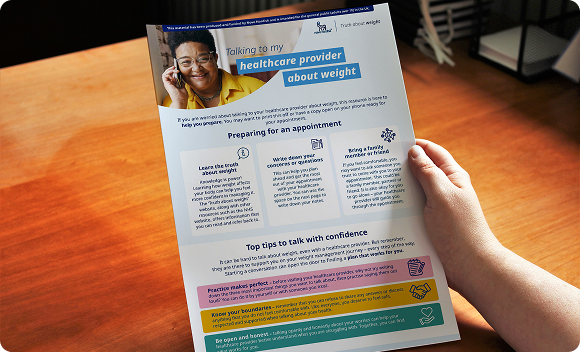
Remember, you are not alone. Your healthcare provider is there to help support you in managing the challenges of excess weight. Find out how you can have open and meaningful conversations by using the ‘Talking to my healthcare provider’ guide.


What are the common myths about excess weight and obesity?

Although obesity is recognised as a chronic and complex disease, it is still not widely understood.

Here, we debunk some common myths.

Myth: excess weight is caused by poor willpower or laziness

  • Truth: obesity is often thought to be caused by a lack of willpower or laziness. But this is far from the truth. In fact, there are many things that can cause excess weight, which you can explore in the section above.

Myth: obesity is not a disease

  • Truth: people often think that those who are obese have made poor lifestyle choices. However, obesity is recognised by experts worldwide as a complex, chronic disease. By recognising obesity as a medical condition, healthcare services and national governments can provide appropriate care for those affected. It also helps raise awareness
to society that obesity is not caused by one’s poor willpower or laziness.

Myth: obesity is not a disease

  • Truth: childhood obesity is a serious health concern, which can have long–lasting effects. Children who have excess weight are more likely to stay overweight or live with obesity in their adulthood.

How well do you understand why weight matters? 

Take this 2-minute quiz now to find out. This quiz covers everything from the causes of excess weight
to debunking common myths. Get started now to learn more about this important health topic.

Question 1 of 8

Why weight matters

Question 1

What is obesity?

Obesity does not cause loss of hearing or a rash of skin. However, it may cause the development of some serious health conditions, including damage to joints.

Obesity is often thought to be caused by a lack of willpower or laziness. But this is a common misconception. There are many things that can cause obesity, such as genetics, underlying health conditions or side effects from certain medicines.

Obesity is often thought to be caused by a lack of willpower or laziness. But this is a common misconception. There are many things that can cause obesity, such as genetics, underlying health conditions or side effects from certain medicines.

0% answered this correctly

Question 2

How is ‘overweight’ defined?

Overweight is a condition of having excess body fat, with a BMI of 25–29.9 kg/m2. People who have an Asian, Chinese, Middle Eastern, Black African or African-Caribbean family background are considered to be overweight when they have a BMI of 23–27.4 kg/m2 Being overweight affects more people than you may think. In 2023 to 2024, 64.5% of adults aged 18 years and over in England were estimated to be overweight or living with obesity.

Overweight is a condition of having excess body fat, with a BMI of 25–29.9 kg/m2. A BMI below 18.5 kg/m2 is classified as underweight.

Overweight is a condition of having excess body fat, with a BMI of 25–29.9 kg/m2. A BMI below 18.5 kg/m2 is classified as underweight.

0% answered this correctly

Question 3

What causes excess weight?

There are many things that can cause a person to become overweight or develop obesity. It’s a complex combination of lifestyle and environment, genetics, underlying health conditions and medicines.

While lifestyle factors may play a part in the development of obesity, it is not a lifestyle choice. It is a disease with serious health implications, which can develop over time and at any age.

While lifestyle factors may play a part in the development of obesity, it is not a lifestyle choice. It is a disease with serious health implications, which can develop over time and at any age.

0% answered this correctly

Question 4

What are the ways to check if you are at a healthy weight? (select all that apply)

Body mass index, also known as BMI, is a way of measuring if an adult is at a healthy weight. It’s a useful guide to classify underweight, healthy weight, overweight and obesity in adults.

0% answered this correctly

Question 5

Which of the following is a symptom associated with obesity?

Obesity can cause more stress on the joints due to the pressure from excess weight on the body. This can limit mobility and make it difficult to carry out day-to-day activities like climbing stairs.

Obesity does not cause loss of hearing. However, it may cause the development of some serious health conditions, including damage to joints.

Obesity does not cause loss of hearing. However, it may cause the development of some serious health conditions, including damage to joints.

0% answered this correctly

Question 6

Obesity increases the risk of which of the following health conditions?

Obesity can increase the risk of many serious health conditions, not just type 2 diabetes.

Obesity can increase the risk of many serious health conditions, not just type 2 diabetes.

Obesity can increase the risk of many serious health conditions, not just type 2 diabetes.

Obesity can increase the risk of developing many serious health conditions, including type 2 diabetes, high blood pressure, liver disease and many more.

0% answered this correctly

Question 7

Obesity is caused by poor willpower or laziness – true or false?

Obesity is often thought to be caused by a lack of willpower or laziness. But this is a common misconception. There are many things that can cause obesity, such as genetics, underlying health conditions or side effects from certain medicines.

Obesity is complex, long-term condition, caused by a range of factors, such as genetics, environment, underlying health conditions or side effects of certain medicines.

0% answered this correctly

Question 8

Obesity is a health condition – true or false?

Obesity is recognised by experts as a complex, long-term condition.

Obesity is often misunderstood by others as a person who makes poor lifestyle choices. In fact, it’s recognised by experts as a complex, long-term condition.

0% answered this correctly

You're well on your way

Looks like there is still room for improvement. Learn more about obesity below.

Good job

Well done you! You are well on your way to becoming ‘in the know’ on obesity. Keep learning to get that 100% next time.

Perfect!

You know your stuff! If your friends are as sharp as you, you can send them a challenge.

What is obesity?

How is ‘overweight’ defined?

What causes excess weight?

What are the ways to check if you are at a healthy weight? (select all that apply)

Waist-to-height ratio helps measure excess fat. A waist to height ratio of 0.5 or higher means a person may have increased health risks.

Which of the following is a symptom associated with obesity?

Obesity increases the risk of which of the following health conditions?

Obesity is caused by poor willpower or laziness – true or false?

Obesity is a health condition – true or false?


Think you might be living with obesity or excess weight?

  • Find out more about living with excess body weight.


Guide: how to talk to your healthcare provider

  • Find out how you can have open and meaningful conversations with your healthcare provider.


References

  1. World Health Organization (WHO). Obesity and overweight. Updated 2025. (Website - accessed December 2025).
  2. NHS England. Health Survey for England, 2022. Part 2. (Website – accessed December 2025).
  3. The Scottish Health Survey, 2023. Volume 1: main report. (Website – accessed December 2025).
  4. National Survey for Wales headline results, April 2022-March 2023. (Website – accessed December 2025).
  5. Healthy Survey (NI) First Results (2023/24). (Website – accessed December 2025).
  6. National Health Service (NHS). Obesity. Updated 2023. (Website - accessed December 2025).
  7. National Institute for Health and Care Excellence (NICE). Overweight and obesity management. Updated 2025. (Website - accessed December 2025).
  8. Patient.info. Obesity: Causes and Treatment. Updated 2025. (Website -accessed December 2025).
  9. Medic G, Wille M, Hemels MEH, 2017. Short- and long-term health consequences of sleep disruption. Nature and Science of Sleep. 9:151–161.
  10. Obesity Action Coalition (OAC). Common Myths about Obesity. Updated 2025. (Website - accessed December 2025).
  11. Obesity.net. Myths About Obesity. Updated 2024. (Website - accessed December 2025).
  12. National Health Service (NHS). Obesity: Causes. Updated 2023. (Website - accessed December 2025).
  13. National Health Service (NHS). Osteoarthritis. Updated 2025. (Website - accessed December 2025).

All images are for illustrative purposes only.

UK25OB00138 | December 2025